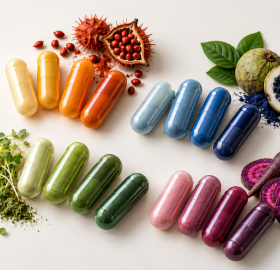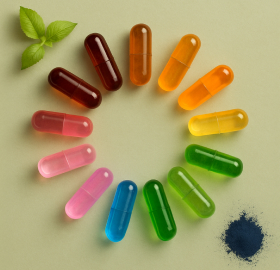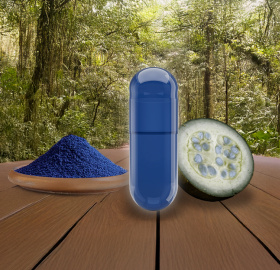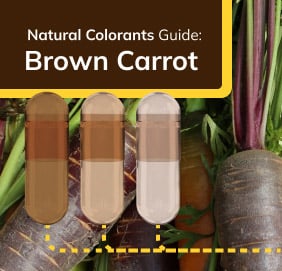

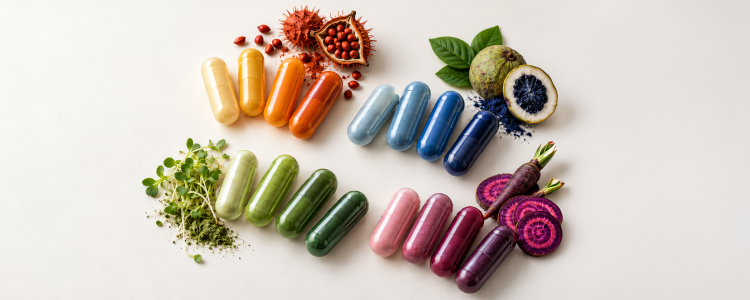
Natural capsule colorant shades can span multiple tonal variations from the same natural source, giving formulators and brand managers more visual possibilities when developing clean-label capsule designs.
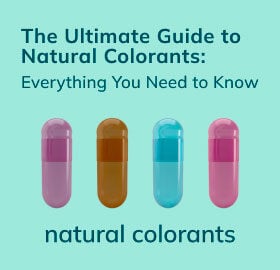
That range matters. A natural colorant should not always be viewed as one fixed color, but as a source that can offer several documented shades. Lyfe Group’s guide to natural colorants provides broader context on how these options fit into K-CAPS® HPMC capsules.
Comparing the Natural Colorant Shade Range
Lyfe Group’s current K-CAPS® natural colorant portfolio includes 12 documented colorant options. Some stay within a single color family, while others extend across related families such as yellow to orange or gray to black.
|
Yellow · 3 shades
|
Yellow → Orange · 5 shades
|
|
Purple · 3 shades |
Brown · 3 shades
|
|
Pink · 4 shades
|
Blue · 5 shades
|
|
Blue · 3 shades
|
Green · 5 shades
|
|
Blue → Green · 3 shades |
Green · 2 shades
|
|
Gray → Black · 3 shades
|
Caramel · 4 shades
|
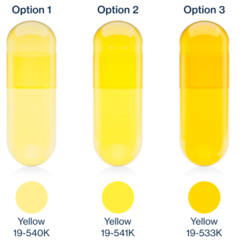
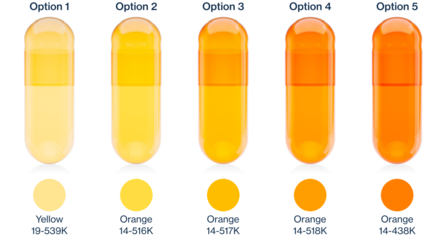
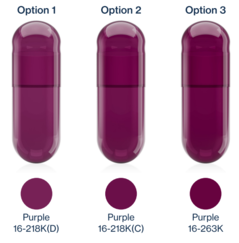
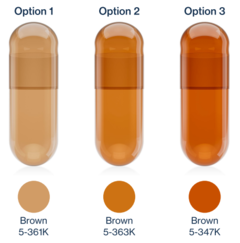
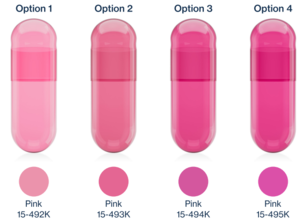
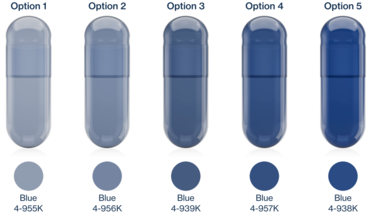
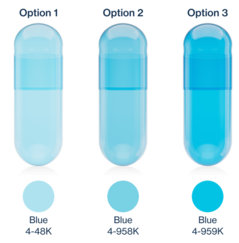
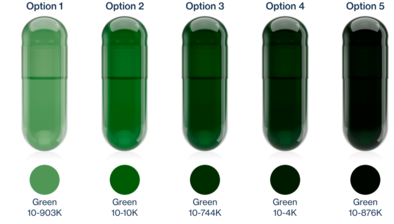
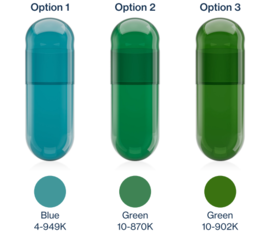
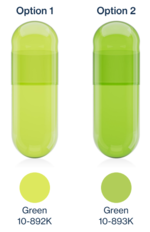
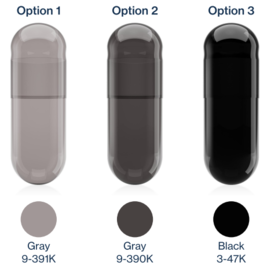
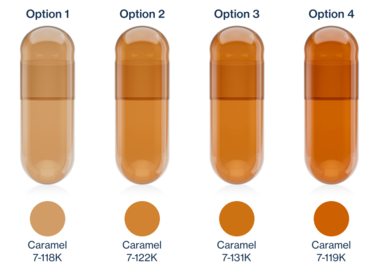
The shades shown are approximate references and may differ from the appearance of the final HPMC capsule.
Natural vs. Synthetic Shades: What Should Formulators Expect?
Compared with synthetic options, natural colorants have a different stability profile because they do not rely on synthetic additives and preservatives to maintain color consistency.
Natural ingredients also have inherent variability. As a result, shades may vary slightly from batch to batch without indicating a change in capsule performance. Some natural colorants can also fade after prolonged UV or IR exposure, making packaging design an important consideration.
For additional formulation and visual considerations, see our guide to capsule color selection.
What to Define Before Requesting a Natural Color Sample
Once you have identified a color family and reviewed the available shade range, the next step is to narrow the visual direction for your capsule project.
Before requesting samples or discussing customization with a supplier, define:
- Your preferred color family and shade references. Use the K-CAPS® chart to identify the options closest to the intended product appearance.
- Whether you need a single shade or a broader visual range to evaluate. Several natural sources offer multiple documented variations within the same family.
- The capsule material you want to evaluate. Final color should be reviewed on the actual HPMC material rather than judged only from a digital or printed reference.
- Packaging considerations. If the selected natural colorant is sensitive to prolonged UV or IR exposure, packaging should be part of the discussion from the beginning.
Because on-screen and printed colors may not exactly represent the finished capsule, Lyfe Group recommends evaluating physical HPMC color samples, also known as film strips, before finalizing the visual specification.
This gives formulation and brand teams a more practical basis for discussing shade development with Lyfe Group’s sales and technical teams.
Explore More K-CAPS® Color Possibilities
The K-CAPS® natural colorant portfolio gives formulators and brand managers a broad range of clean-label capsule color options without limiting each natural source to a single visual result.
Explore your capsule customization possibilities with our Capsule Simulator. Then request a quote or contact Lyfe Group’s sales team to discuss available K-CAPS® customization options for your formulation.